When the Lab Bench Empties: The Coming Handover of American Principal Investigators
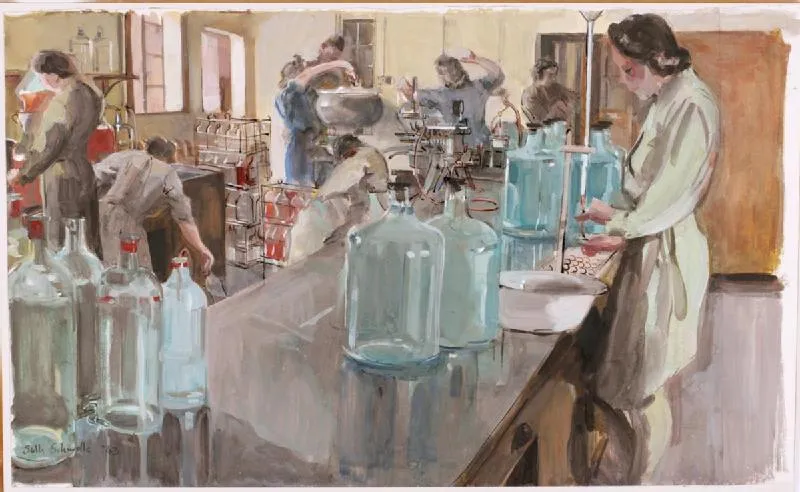
Photo: Stella Schmolle, Public domain, via Wikimedia Commons
The American research university has always treated the departure of a senior scientist as a private event — a retirement party, a final grant closeout, a name plate removed from a door. What the system has never treated as a collective event is now arriving all at once. Across departments of biology, chemistry, psychology, and engineering, the cohort of principal investigators hired during the expansion of the 1990s is reaching retirement age in concentrated numbers, and the exit is not a trickle but a demographic wave.
The question facing deans, department chairs, and — most urgently — the mid-career scientists waiting in the wings is not simply who will fill the vacant labs. It is what, precisely, will be lost when decades of accumulated judgment walk out the door with them.
The Demography Nobody Planned For
The pipeline that produced today's senior faculty was never designed with a handoff in mind. Faculty hired between 1990 and 2010 entered institutions during a period of sustained growth in federal research funding, particularly after the NIH budget doubling in the late 1990s. They built labs, trained successive generations of postdocs, and settled into R01 portfolios that could span twenty or thirty years. Mandatory retirement ages, abolished for most university faculty in 1994, meant that many of these investigators simply never stopped.
The result is a compressed departure schedule. Rather than a steady turnover rate of a few percent per year, many departments now face the prospect of losing a third or more of their lab-leading faculty within a single decade. Search committees can hire replacements. What they cannot easily hire is the institutional memory embedded in those careers.
What Leaves With the Investigator
Sociologists of science have long distinguished between explicit knowledge — protocols, publications, datasets — and tacit knowledge: the unwritten craft of running a laboratory. The tacit category is where the losses concentrate. It includes the instinct for which postdoctoral candidate will thrive in a particular lab culture, the phone-call relationships with program officers at federal agencies, the hard-won understanding of which instrument vendors overpromise, and the undocumented workarounds that make a difficult assay reproducible.
Consider the funding relationship alone. A senior investigator who has served on study sections for two decades knows, in a way no onboarding document can convey, how a center grant application is actually evaluated — which framing survives review, which preliminary data a panel will demand, how to signal feasibility without overpromising. When that investigator retires without a deliberate transfer process, the department inherits the grant, if it inherits anything at all, but not the judgment behind it.
Early Experiments in Documentation
A handful of institutions have begun treating the retirement wave as a methodological problem rather than an administrative one, and their early findings are instructive precisely because the efforts so often fall short.
Structured exit interviews, modeled on corporate knowledge-management practice, have proven useful for capturing procedural content — how the lab orders reagents, how animal protocols are renewed — but consistently fail to capture relational knowledge. A retiring investigator can describe their workflow with a program officer; they cannot easily transmit the trust that made the phone calls productive.
More promising are apprenticeship-style handoffs, in which a designated successor — often a long-tenured research professor or lab manager rather than a new tenure-track hire — shadows the departing scientist for a final year or two. A few medical schools have formalized this as a "continuity appointment," though such arrangements require bridge funding that most departments lack. Where they have been attempted, the evidence is anecdotal but consistent: labs with a deliberate handover period retain personnel, maintain productivity, and are far more likely to survive a grant's mid-cycle review.
The Inheritance Problem
There is a distributional dimension that deserves attention. The departing generation accumulated resources — equipment, space allocations, multi-investigator awards — under rules that rewarded accumulation. Their successors inherit both the assets and the obligations: aging instrumentation with no service contract, shared facilities whose costs were subsidized by grants now expiring, and collaborative commitments entered into decades earlier.
Junior faculty stepping into these roles report a striking asymmetry. They are handed the trappings of a mature research operation while being evaluated, for tenure purposes, as if starting from zero. Some universities are beginning to adjust tenure clocks and startup calculations to account for inherited infrastructure; most have not.
Treating Handover as Method
The deeper lesson from the institutions now scrambling to adapt is that knowledge transfer in science is not an HR function — it is a methodological one. If reproducibility depends on tacit craft, as much of the replication literature suggests, then the departure of the scientists who hold that craft is itself a threat to the reliability of the research record.
A few practical reforms follow naturally. Departments could require a documentation plan as a condition of retirement-phase bridge funding, the way data management plans are now a condition of grants. Professional societies could develop handover protocols for specialized techniques that exist in only a handful of labs nationwide. Agencies might fund successor transitions explicitly, treating continuity of expertise as a deliverable rather than an accident.
None of these measures will fully solve the problem. Tacit knowledge resists capture by design — that is what makes it tacit. But the alternative, now visible in departments that have already lost a generation without preparation, is a patchwork of orphaned labs, lapsed collaborations, and techniques that survive only in the citation records of papers no one can replicate.
The wave is coming regardless. The only open question is whether American science treats the largest faculty turnover in its modern history as an emergency to be survived, or as a methodological challenge to be studied, documented, and met.